More Than Numbers. A Legacy of Love, Sacrifice, and Opportunity.

Two Communities. Distinct Stories. One Stronger LA Economy.
In both Armenian and Iranian cultures, there is a small word that carries a lifetime of meaning.
“Jan.”
A term of endearment expressing love, warmth, and belonging. A reminder that even when years pass or conversations become infrequent, the bonds of family and community endure.
Some connections never need explaining. They are simply felt.
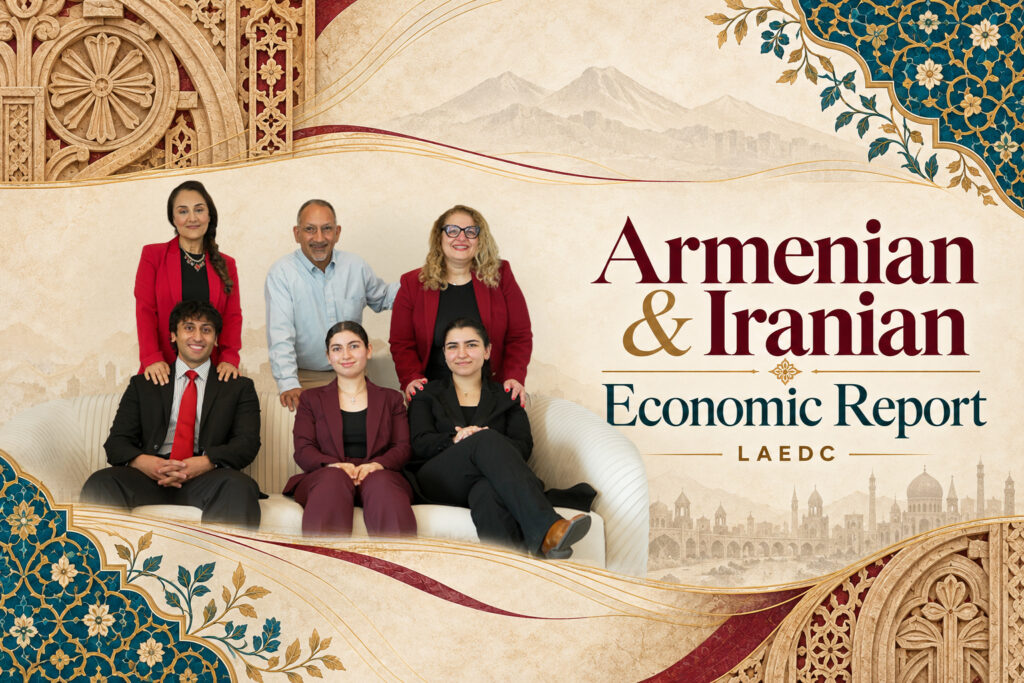
That spirit filled the room on October 20 at Shiraz in Glendale, where community leaders, families, partners, and LAEDC staff celebrated the release of the Armenian & Iranian Economic Report.
What began as a celebration of research became something deeply personal: recognition of families who made Los Angeles their home, built businesses and careers, raised children, and established institutions that keep their cultures alive.
For first-generation immigrants, the evening acknowledged the challenges of starting over. For their children, it illuminated the determination behind the opportunities they inherited.
For both generations, it was a chance to see their family’s story become part of Los Angeles County’s economic story.
A Lifetime in Los Angeles. A Legacy Worth Recognizing.
For Halé Behzadi, former LAEDC Board Chair and BMO’s Vice Chair for California, the evening was deeply personal.
“This report is deeply personal to me.”
Forty-one years ago, Behzadi arrived in Los Angeles for a professional opportunity. She met her husband here. Together, they built a family and a life rooted in community.
“I’ve built my family here.”
Her journey reflects something statistics cannot capture: Los Angeles is more than a place to find work.
It is where newcomers become neighbors. Where uncertainty becomes possibility. Where a new beginning becomes a family’s history.
Behzadi described the report as a source of pride, validating contributions long recognized within the community but now documented through research.
She also emphasized the importance of identifying one’s heritage so communities are represented in decisions affecting their futures:
“It’s like not being in the room when a decision is made for you.”
Her message was clear: Being counted means having a voice in decisions that shape the future.
The Stories Our Parents Carried
Dr. Narineh Makijan, an Armenian immigrant from Iran who grew up in Glendale, helped advocate for the research.
“The reason why I was pushing wasn’t for any other reason but to give us a voice.”
That voice belongs to generations of families who built livelihoods, preserved traditions, and created opportunities for their children.
LAEDC research analyst Arman Koohian reflected on growing up second-generation, without facing the same challenges his immigrant parents experienced.
His hope is to honor those experiences, preserve cultural identity, and expand opportunities for younger Armenians and Iranians.
One generation made the journey. Another carries the responsibility of remembering why.
The Economic Power of Belonging
LAEDC’s report identifies approximately 191,800 Los Angeles County residents reporting Armenian ancestry and 87,600 reporting Iranian ancestry. These estimates overlap and should not be added together.
It also finds that 21.5% of Armenian workers and 29.6% of Iranian workers are self-employed, compared with 13.5% countywide.
Behind those figures are businesses sustaining livelihoods, neighborhoods, traditions, and generations.
Though Armenian and Iranian Angelenos have distinct histories and identities, both communities demonstrate how cultural connections strengthen economic opportunity.
A familiar language spoken across a shop counter. A mentor helping a newcomer find work. A family business creating opportunities for the next generation.
These connections are part of the economic fabric of Los Angeles.
A Story That Must Continue
LAEDC President and CEO Stephen Cheung captured the importance of preserving these stories:
“When you don’t tell the story, it gets washed over.”
The report makes these contributions visible while identifying opportunities to strengthen entrepreneurship, workforce pathways, access to capital, and community investment.
But its greatest promise lies in what happens next.
Will more families build secure futures? Will young people discover opportunities their parents never had? Will community voices shape decisions affecting generations to come?
Because the most meaningful way to honor yesterday’s sacrifices is to create tomorrow’s opportunities.
Perhaps that is the enduring spirit of Jan: a connection reaching beyond one person, one family, or one generation.
Two Communities. Distinct Stories. One Stronger LA Economy.
Coalition of One. Economy for All.



Responses