

LAEDC Los Angeles Wildfires: Economic Update #3

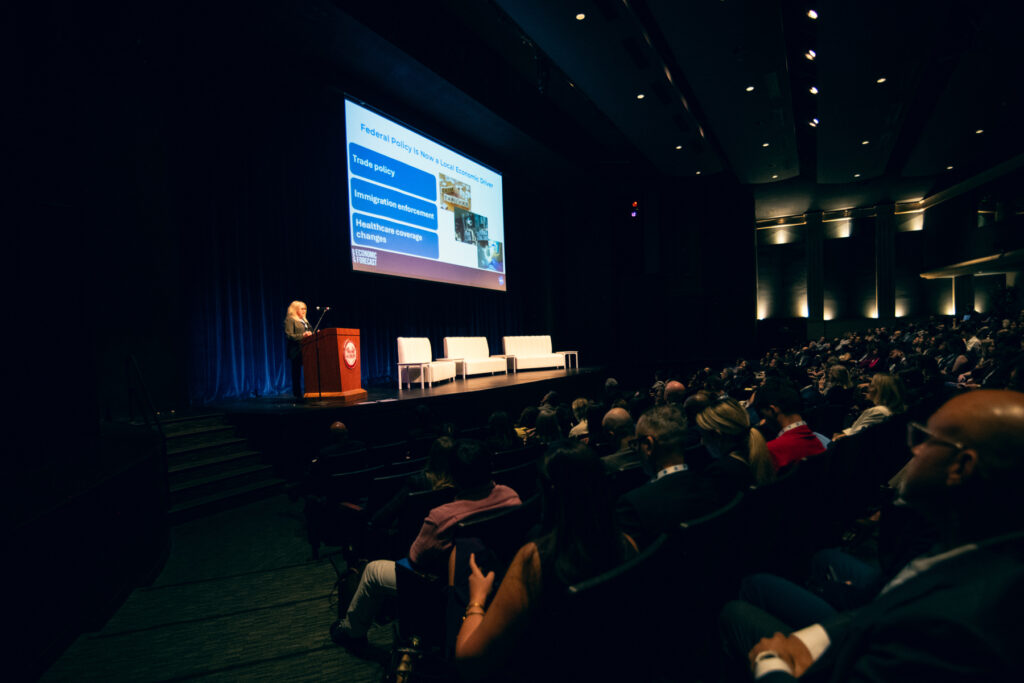
This brief provides a written synthesis of the findings presented in Los Angeles Wildfires: An Economic Update #3, delivered by the LAEDC Institute for Applied Economics, in collaboration with the Los Angeles County Department of Economic Opportunity (DEO), in June 2026. It is the third installment in a quarterly series designed to monitor the economic impacts of the Eaton and Palisades wildfires over time.
The intent of this analysis is to examine the evolving economic impacts and recovery dynamics associated with the Eaton and Palisades wildfires, with a focus not only on immediate disruption, but also on the longer-term conditions shaping recovery across affected communities. Building on findings released in our first two briefings in September 2025 and January 2026, this update focuses specifically on reoccupation and community functionality as indicators of sustained recovery.
It is important to note that rebuilding and recovery are not necessarily the same thing. While rebuilding is visible and can be measured through permits, construction activity, debris removal, and physical redevelopment, recovery is broader. Recovery is reflected in whether people are able to return to their homes and communities, whether businesses can reopen sustainably, whether schools regain enrollment, whether transit systems recover ridership, and whether day-to-day economic activity resumes. In other words, recovery becomes durable when communities begin functioning again.
To better understand the pace of recovery, the analysis examines indicators tied to resident return such as USPS vacancy rates and rebuilding permit activity; business recovery indicators, including QCEW reporting patterns and signs of prolonged non-reporting; mobility indicators, including changes in Metro ridership patterns; and the return of critical community amenities and services such as schools, healthcare access, and food access. It also examines the economic implications of delayed reoccupation itself, including impacts on local spending activity and broader economic stabilization, as well as how rapid housing strategies can support housing stabilization and a more durable recovery trajectory.
Top-level findings indicate that while residential and business recovery have shown positive momentum, there are important caveats. These include a demonstrated weakness in the number of completed housing permits coupled with the looming expiration of temporary housing insurance coverage. Reopening businesses also have some weakness in hiring, while transit-related mobility indicators show mixed signs of recovery. Moreover, there has been a slow return of schools, health facilities, and grocery stores. This delayed reoccupation is costing Altadena and the Palisades significant amounts in lost spending.
This quarterly update is intended as an analytical reference for policymakers, business leaders, workforce and housing stakeholders, and the broader public. It focuses on establishing a clear empirical baseline to inform ongoing recovery efforts and future updates in this series.
Resident Return
Vacancy rates after a wildfire are an important metric for assessing how quickly an area is repopulating. While vacancy rates increase substantially in the wake of a wildfire, subsequent declines generally signal repopulation.
The analysis calculated vacancy rates for both fire areas using USPS data. This data is only available at the census tract level, so the rates will include some addresses outside the primary fire areas. Vacancy rates rose dramatically in the quarter of the wildfire. In the post-fire period, while the Eaton Fire area has seen a decline in vacancy rates, the Palisades Fire area has not.
To compare the Eaton and Palisades wildfire recovery with other wildfires, the analysis examined rebuilding permit issuance and completion (certificate of occupancy) for destroyed buildings. As of April 2026, 32.83 percent of total residential structures destroyed by the Eaton wildfire have had rebuild permits issued. For residential structures destroyed by the Palisades wildfire, the figure is 19.87 percent. With respect to the percentage of destroyed residential buildings with a rebuild permit issued, Los Angeles appears to resemble the pattern observed in high-permit-issuance fires, like the Tubbs and Marshall fires. in Across the multiple jurisdictions, we estimated that it took an average of 79 days from rebuild permit application to issuance.
However, with respect to the percentage of destroyed buildings that have been rebuilt, Los Angeles 15 months after the fire appears to resemble a rebuild-completion path seen with low-permit-completion fires, such as the Maui and Camp fires. As of April 2026, 0.62 percent of total residential structures destroyed by the Eaton wildfire have had finaled/certificates of occupancy issued, while 0.31 percent of total residential structures destroyed by the Palisades wildfire have had finaled/certificates of occupancy issued. Across jurisdictions, we estimated that it took an average of 193 days from application to rebuild completion.
Business Recovery
Looking at how businesses have been recovering after the fire, the analysis focuses on Quarterly Census of Employment and Wages (QCEW) data, which provides economic activity data for each business establishment in Los Angeles County. Establishment entrance refers to when a business establishment is recorded as opening in an area, and an increase in these rates can indicate a recovery in business activity. In the quarter of the fire and after, entrance rates significantly dropped in both areas, while the rest of LA County remained consistent with its trend. However, there was a significant increase in entrance rates from Q3 to Q4 2025, signaling that business activity is gaining momentum. That said, the entrance rate in both areas remains significantly lower in Q4 2025 than in Q4 2024.
Business establishments are required to report on a regular basis their number of employees and other economic data to federal and state entities, and the repeated non-reporting of economic data can indicate that an establishment is no longer active. Examining how these no-report rates change over time can then show that business operations are leaving or returning to an affected area. Both fire areas have seen elevated no-report rates in the post-fire period, which are much higher than in the rest of LA County. However, both areas have seen these rates decline between Q3 and Q4 2025. Despite the gains, consecutive no-report rates remain elevated in Q4 2025 for the fire areas.
The reactivation of an establishment, or the reopening of a business after a temporary closure, is a critical metric that, when increasing, can indicate an area’s economic activity is recovering after a disaster. There has been a sharp increase in reactivation rates between Q3 and Q4 of 2025 for both fire areas, well above the County’s rates. The reactivation rate in Q4 of 2025 was substantially higher for both fire areas than the previous year, indicating that reactivation rates are continuing to accelerate.
The regrowth in the number of employees within a natural disaster area is another important metric for measuring the return of business activity. Dividing the number of employees in an area by the number of active establishments provides the number of employees per establishment or “employment rate.” While the employment rate had been trending down in the County, this metric declined significantly more in both the Eaton and Palisades areas after the fire. The employment rate in both areas has been declining consistently since the fire, suggesting that establishments are hiring fewer employees on average.
The analysis also looked at job postings as a signal of business recovery. Because the postings data cannot be geocoded to exact job sites, place-based measures were used when available: the Altadena Census Designated Place, where that geography is available, and keyword searches for postings that reference Altadena, Eaton, or Palisades-related place names. As expected, the results suggest that place-referenced hiring activity declined in 2025. Altadena CDP postings fell by 8.2 percent, Altadena and Eaton keyword postings fell by 21.1 percent, and Palisades keyword postings fell by 38.4 percent. These are not exact job-site counts—they show postings that reference these places, not every job physically located in the fire areas—however, as a directional indicator, the pattern suggests that local hiring activity connected to these communities remained below pre-fire levels throughout 2025.
The composition of the decline points largely to local-serving roles. In the Altadena and Eaton keyword search, the largest declines included home health and personal care aides, automotive service technicians, registered nurses, personal financial advisors, teaching assistants, retail salespersons, and preschool teachers. These are roles tied closely to resident activity, schools, care services, retail, and daily neighborhood services. For the Palisades keyword search, the declines were similar but sharper. At the same time, recovery-adjacent roles increased in both place-reference searches. Place-based data suggests two things happening at once: local-serving hiring declined, while some recovery-related roles began to grow.
A tiered keyword approach was used to look more directly at recovery and rebuilding demand. Tier 1 is the most conservative measure, capturing postings that explicitly reference the Eaton Fire, Palisades Fire, Altadena Fire, Pacific Palisades Fire, Los Angeles wildfires, or January 2025 fires. Tier 2 captures postings that reference affected places and also include recovery terms, such as rebuilding, debris, cleanup, and remediation. Tier 3 is broader, capturing countywide recovery-adjacent activity, such as debris removal, hazardous materials, environmental remediation, and rebuilding. These tiers help separate direct fire references from broader recovery signals.
The recovery keyword results move in the opposite direction from the place-reference measures. While place-referenced postings declined, rebuild-related and recovery-adjacent postings increased countywide. Construction managers had the largest increase, while project management specialists also increased substantially. The main takeaway is that labor demand connected to rebuilding and recovery did materialize, even as place-referenced local hiring remained soft during this time. Thus, the recovery is moving, but unevenly, where the recovery economy is active, but local business recovery remains incomplete.
Mobility
Transit ridership helps show whether people are returning to daily routines, work, services, and community activities. The Metro routes disrupted by the fires include lines 602, 134, 660, and 662, where the fires affected service availability, access, or travel patterns. Across the four disrupted lines, Q1 2025 ridership was down 38.9 percent compared with Q1 2024. The steepest declines were on the Palisades-related lines. The declines likely reflect both reduced travel demand and reduced service availability. By Q1 2026, these disrupted lines had improved from their early 2025 lows, however they remained 17.7 percent below Q1 2024 ridership. This pattern suggests improvement, but not full recovery: Ridership has moved in the right direction, but the affected routes still lag their pre-fire baseline.
Pasadena Transit, which serves as the primary local transit provider for Altadena, tells a different story. Fixed-route ridership dropped in January 2025, which aligns with the immediate disruption from the fires. But by February 2025, ridership had rebounded above its adjusted 2024 baseline. Pasadena then generally remained above its adjusted 2024 baseline and by Q1 2026, Pasadena fixed-route ridership was 22.6 percent above its adjusted Q1 2024 baseline.
Community Functionality
Many public schools, private schools, daycare centers, and preschools were severely damaged or destroyed in the fire. The analysis focused on public school rebuild and enrollment, given the availability of data, and it shows that the return of students has been uneven. In the Palisades, three public schools were significantly damaged or destroyed, and LAUSD expects these schools to be rebuilt and open by the end of 2028, a faster timeline than originally anticipated. Two of the schools are operating on their campus in temporary structures, and one is co-locating with another public school. In Altadena, three public schools were fire-damaged. These schools have announced plans to rebuild on their original location, but timelines have not yet been established. It should also be noted that while both fire zones saw a faster decline in enrollment than the County at large in the 2025-26 school year, the difference in enrollment decline in Palisades and Altadena hints at a trend in returning: families in Altadena were more likely to keep their children enrolled in the same school, while in the Palisades families switched to schools outside of the fire zone.
The return of health services and food services to affected communities has also been slow, and this could delay the return of residents. In Altadena, an AltaMed Clinic was destroyed. As AltaMed plans to rebuild, it is operating mobile clinics and referring patients to other branches. An Aldi grocery store was destroyed but has announced its intentions to rebuild. The Altadena Grocery Outlet reopened in February after abating smoke damage. In the Palisades, UCLA Health Family and Internal Medicine Center was destroyed with no announced plans to rebuild, potentially leaving a gap in the Palisades for health services. A CVS Health in the Palisades was damaged, but was able to reopen in September 2025, along with a Chipotle and Anawalt Lumber. As part of the Palisades Village reopening, Erewhon, which was damaged in the fire, is expected to reopen in August of 2026, alongside 90% of the tenants in the Village. Gelsons and Ralphs, which were both destroyed in the Palisades fire, plan to rebuild. Early indications estimate that they will be open by 2030.
Housing Stabilization
The obstacles faced by displaced families will evolve in 2026, as displacement coverage, which pays for temporary housing, storage, and other expenses associated with displacement, runs out for many. Of those with a standing home, more than half have returned home, with some living at home while repairs continue. For those who suffered a total loss, displacement rates have declined slightly, driven by families who bought new homes outside of the burn areas. About 38% of survivors have already or will soon run out of displacement coverage. With only 16% maintaining coverage past April 2027, this year will see many survivors run out of displacement coverage before they are able to return home. As ability to afford housing after displacement coverage directly correlates with household income, this year will see tough decisions for low- and middle-income families and requires creative solutions to help those who would like to return home to bridge the financial gap.
There are potential solutions, however. One such creative initiative, the Altadena Rapid Housing Solution, is helping families return to their properties as their housing is being rebuilt. The first step is to move families back onto their land in RVs, provided through grants to low-income households, while coordinating with utilities to restart services to the land. This helps households whose displacement coverage has run out, while simultaneously increasing foot traffic and injecting revenue into fire-impacted communities. It also allows time for the building of medium-term housing (an ADU) which families can then move into while their permanent home is being rebuilt. Once the main home is complete, the ADU can serve as additional revenue for the household as well as additional housing to further increase community vitality.
Economic Activity
The analysis also estimates what might be the cost of delayed reoccupation in terms of lost local household spending, which could slow the broader economic recovery within affected communities. The analysis focuses primarily on homes that were destroyed (meaning homes with greater than 50% damage to the structures) or sustained major damage (defined as 26–50% damage to structures), as these households are expected to face the longest rebuilding timelines, the greatest displacement, and the most prolonged disruptions to their normal local spending patterns. In contrast, homes with minor or limited damage are more likely to remain occupied, return to occupancy more quickly, or experience only temporary disruption. Focusing on the destroyed and major damaged homes, it is estimated that annual localized spending losses from delayed reoccupation of those households are about $79 million in Palisades and $73.6 million in Eaton.
These spending loss estimates result from the fact that over 15,700 housing units were destroyed or damaged across both fire areas. Roughly 87% were classified as destroyed, meaning most households are likely to face prolonged rebuilding timelines and delayed reoccupation. These residents support neighborhood economic activity through everyday spending on retail, dining, healthcare, and personal services, and every year a household remains displaced is another year of lost spending on these local businesses.
Moreover, the spending losses are broad-based, spreading across households at all income levels. The two fire areas have distinct income profiles: Palisades has a high concentration of households earning over $200,000 annually, while Eaton shows a broader distribution across income levels. Since spending behavior varies by income, income-specific spending profiles were applied to calculate the over $150 million annual localized spending losses from delayed reoccupation.
To reinforce the key takeaway: household displacement temporarily removes significant purchasing power from local communities across all income levels. The cost of lost local spending can be as high as $150 million each year. Together, these impacts highlight why accelerating household reoccupation is one of the most effective drivers of economic recovery.
Concluding Remarks
The analysis emphasized the importance of centering reoccupation as a key recovery metric. It examined the available evidence with respect to the restoration of businesses, mobility, community services, and housing, and finally to the estimated economic costs of delayed reoccupation in terms of lost local spending. The central message, once again, is that accelerating reoccupation is not just about rebuilding homes; it is about restoring the economic fabric of these local communities.
Key Takeaways
- Recovery has entered a new phase. The focus is shifting from measuring wildfire damage and rebuilding activity to assessing whether residents, businesses, workers, and essential services are returning to affected communities.
- Rebuilding and recovery are not the same thing. While rebuilding activity continues, long-term recovery depends on successful reoccupation and the restoration of community functionality.
- Resident return remains uneven. Vacancy rates have begun to decline in the Eaton Fire area, signaling some progress in repopulation, while similar improvements have not yet been observed in the Palisades area.
- Permitting activity is advancing faster than completed rebuilding. Fifteen months after the fires, approximately 26.7% of destroyed structures had received rebuilding permits, but only 0.47% had completed reconstruction and received final occupancy approval.
- Business recovery indicators show positive momentum. New business entry rates, business reactivations, and reductions in business no-reporting all improved during the second half of 2025, suggesting increasing economic activity in both fire areas.
- Employment recovery continues to lag. Businesses may be reopening, but employment per establishment remains below pre-fire levels in both the Eaton and Palisades fire areas.
- Local hiring activity remains below pre-fire levels. Place-referenced job postings declined by 8.2% in Altadena, 21.1% in Altadena/Eaton-related postings, and 38.4% in Palisades-related postings during 2025.
- Recovery-related labor demand is growing. Demand increased for occupations tied to rebuilding and recovery, including construction managers, project managers, environmental specialists, social workers, and field operations personnel.
- Mobility recovery is mixed. Metro routes most affected by the fires remained 17.7% below pre-fire ridership levels as of the first quarter of 2026, while Pasadena Transit ridership exceeded its adjusted pre-fire baseline by 22.6%.
- The return of community services remains slow. Schools, healthcare facilities, and grocery stores continue to face rebuilding challenges, creating barriers to sustained resident return.
- Housing displacement remains a major recovery challenge. Approximately 38% of survivors have already exhausted or will soon exhaust displacement assistance coverage, while many households remain years away from returning home.
- Delayed reoccupation can generate significant economic losses. Annual localized household spending losses are estimated at $79 million in the Palisades and $73.6 million in the Eaton Fire area, representing more than $150 million in lost local spending each year.
- Reoccupation is emerging as one of the most important measures of recovery success. The pace at which residents, businesses, schools, healthcare providers, and community amenities return will ultimately determine the long-term economic and social recovery of wildfire-impacted communities.