

Press Release: LAEDC Releases The Latino Report

FOR IMMEDIATE RELEASE
Los Angeles, CA – May 11, 2026 – Today, the Los Angeles County Economic Development Corporation (LAEDC) released La Columna Vertebral (The Backbone), a comprehensive analysis of Latino economic contribution to Los Angeles County. Prepared with data and analysis from LAEDC’s Institute for Applied Economics, the report examines Latino workforce participation, business ownership, healthcare access, foreign direct investment, trade and logistics, and creative economy contributions. It is the most integrated portrait to date of the role Latino communities play in driving the regional economy.
“Our diversity has always been our greatest economic strength, and the Latino community is at the heart of that story. La Columna Vertebral celebrates the workers, entrepreneurs, and families who fuel our small businesses, sustain our industries, and fuel the Los Angeles economy every single day,” said Stephen Cheung, President and CEO of LAEDC and World Trade Center Los Angeles. As we prepare to welcome the world for the World Cup, Super Bowl, and Olympics/Paralympics, our region must invest in the workers, entrepreneurs, and families who built what visitors will come here to see. How we choose to support and partner with Latino communities will shape our region’s prosperity for generations to come.”
Dr. Noel Hacegaba, CEO, Port of Long Beach, adds: “This region is about to welcome the world — the 2026 FIFA World Cup, the 2028 Summer Olympics and a decade of global attention. The trade corridor that feeds this region will only grow more important. When visitors look at our cranes, our rail yards and our cleaner, faster gateway, they should see what I see: a region where Latino communities are not just a segment of the economy. They are its foundation. El comercio es poder.”
The report documents that Latino workers represent 47.5% of LA County’s total workforce, including 56% of manufacturing, 56% of transportation and warehousing, 42% of healthcare, and 63% of accommodation and food services. There are 374,000 Latino-owned businesses in LA County, representing 27% of all firms, and Hispanic employer firm growth reached 41.4% between 2018 and 2023, more than four times the overall rate. Nationally, the U.S. Latino GDP reached $4 trillion in 2023, which would rank as the fifth largest economy in the world if measured independently, with California’s $989 billion Latino economy leading every state.
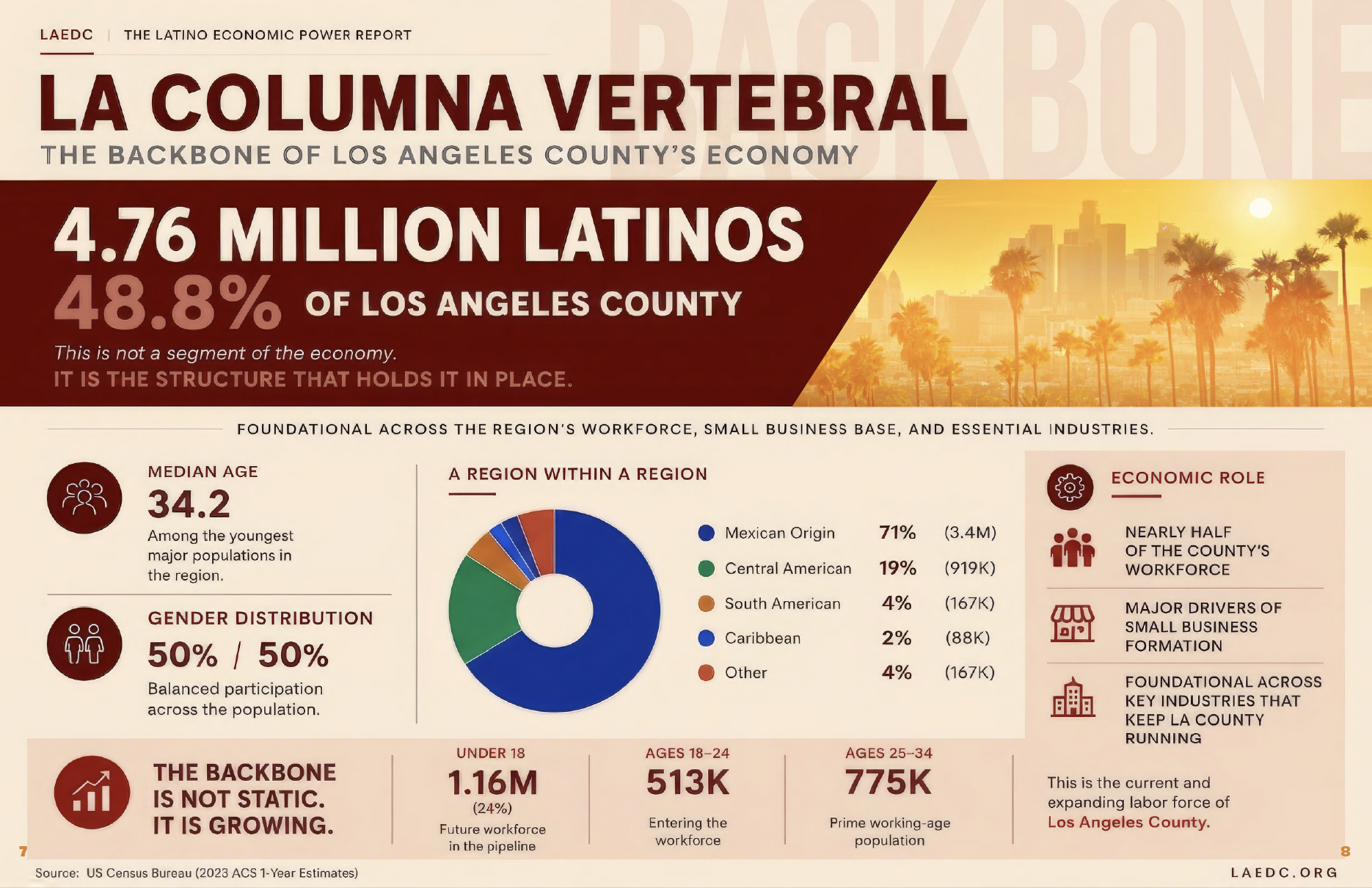
While Latino contributions power nearly every industry in LA County, the report also documents persistent structural barriers. The Latino median annual wage in LA County stands at $39,000 against $78,200 for white non-Hispanic workers. According to LAEDC’s Institute for Applied Economics, the median Latino household holds $59,380 in net worth, compared with $256,000 for white non-Hispanic households. Latino-owned firms generate just 3.8% of total business revenue despite owning 27% of all firms, and 10.1% of Latino adults remain uninsured, more than three times the county rate.
Among the report’s notable findings is a reframing of foreign direct investment that recognizes the more than $160 billion in annual U.S. remittances to Latin America as bidirectional capital flow. This reframing positions Latino families and entrepreneurs as among the most prolific generators of foreign direct investment in the region, alongside the 173 Latin American corporate establishments now operating in LA County, which together employ more than 4,100 workers and pay $435 million in annual wages.
La Columna Vertebral also features a digital roundtable with three generations of Latino business owners. Silvia Olmos of Sylvia’s Pupuseria, Juan Sanjuan III of Gloria’s Restaurant, and Beatriz D Porto of Porto’s Bakery share how they built their businesses across decades of structural barriers. Across three generations, all three named the same three gaps in the LA business ecosystem: capital access, language, and institutional outreach.
The report’s release comes at a critical moment for the region. As Los Angeles prepares to host three of the largest sporting events in the world, the report acknowledges that 2025 brought the largest federal immigration enforcement operation the region has ever seen, concentrated in the same majority-Latino neighborhoods the data identifies as the engine of the LA economy. The report makes the case that any honest accounting of Latino economic contribution must also recognize the conditions under which it is generated.
The release coincides with the activation of the California Jobs First – LA County Collaborative, the regional economic development infrastructure coordinated by LAEDC. Of its more than 800 cross-sector partners, more than 100 are Latino-serving organizations. This reflects a regional economic development model built to include the communities that power the workforce.
READ THE FULL REPORT HERE.
###
Media contact
Josaline Cuesta
(213) 236-4846
[email protected]